Welcome to NakedTomatoes

All about tomatoes, heirloom and home grown.
With a bit extra thrown in about Brugs and bread, growing and baking, and other semi-relevant thoughts. And maybe a few recipes.
Showing posts with label tomatoes. Show all posts

Monday, February 4, 2008

Starting from Scratch...or Seed.....Part two

Anyone who knows me, knows I cannot resist a bad pun! This is my boy, Simon. He is the mellowest fellow, and I adore him even when he is being bad (like getting into my plants). How could I possibly stay mad at that face?

Anyway, back to our regularly scheduled program.........

Planting tomato seed is pretty much the easiest thing in the world. If you've decided to use the cell packs, then simply place one seed in the center of each cell, gently pressing it down just below the soil, and lightly cover it up. If you're using larger pots, you can plant a bunch of seeds in the pots to germinate, and prick them out and transplant once they have grown on a bit. Water very lightly to ensure the seeds are in contact with the soil, and will be able to absorb some of the moisture. Without water, the seeds won't germinate. Don't let the soil dry out until you see the seedlings but don't over-water so that the soil is sopping wet.

Some people use heat mats underneath the trays, or place them on top of the fridge for a bit of bottom heat, which will help speed up the waiting game you will now be playing. I don't specifically use bottom heat, and have never had any problems, but I'm using large greenhouse shelves, that I can close up at night with a light source, which does generate some heat and also retains some moisture. Just be sure that if you use a heat/light source, that it is safe!!! I can't stress that enough! Friends and fellow gardeners have shared many near miss stories, of creative ways they tried to use waterbed heating mats, for example, and nearly burnt their homes down in the process. You may also want to cover up the pots with plastic, or if using the greenhouse style trays that you can purchase, with the domes that come with the trays. Just remember to uncover them during the day, if they are in sunlight, because cooking your seeds will kill them, and that is exactly what will happen if they get too hot under the domes.

Light isn't necessary at this point, just warmth. The ideal temperature should be approximately 25 Celsius (75 F) Germination with tomatoes is usually fairly quick, between 5 -7 days. Once the seeds have popped up, then light does become the number one critical factor in strong and healthy seedlings. I use large shop lights with regular cheap fluorescent bulbs, and a few other lights sources to provide as much light as possible. The seedlings are in my south facing bay windows, so they get as much sun as possible during the day along with the supplemental lighting. The shop lights are hung so close to the seedlings that they almost touch. The one other crucial mistake that is often made, is to over-water the seedlings. Let them get almost to the point of drying out before watering again.

Once they've been growing for a week or two, they should have a second or third set of true leaves, which is a good time to transplant if you are using the large pots/lots of seeds method. If using the cells, then you can leave them safely for a while longer.

One final note, that I should have addressed first, is when to start your seeds. Six to eight weeks before your last frost date is the ideal time to start. If you are an impatient seed starter (as I am) then by all means, take your chances and play around. But remember that the ideal growing condition for tomato plants is outdoors, in full sun. Not very many homes can provide those conditions. And if you do seed early, you may want to try and sow some back up plants at the right time just in case.

Transplanting and trouble shooting.....next time, pardner.


Doesn't she look like she carries a six shooter in her hip pocket??

Mina aka CrazyCalico

Thursday, November 15, 2007

Choosing the right tomato - Part One

First of all, I don't know if there is such a thing. Everyone's taste is subjective, and the right tomato for Tom could be the wrong tomato for Fred. Having said that, the type of tomato you want to grow will depend on what you want out of that tomato. Are you looking for the perfect BLT sandwich tomato? Cute and tasty little plums for salads? Good canners and salsas and pastes? Lots of meat, lots of juice, lots of seeds, no seeds, etc. There are literally thousands of varieties to chose from, and of course every nursery catalog that lists seeds will tell you every tomato seed they sell is terrific. So how do you choose? And are you willing to put up with the imperfections of growing heirlooms? If not, then maybe you should grow some of the hybrids on the market and stick to the same old same old! But if you want to take a chance on something different and have some fun growing tomatoes, then heirlooms are for you.

There is nothing inherently wrong with hybrids but I prefer heirlooms/open-pollinated for a number of reasons. I like growing yellow tomatoes, and orange tomatoes, and black tomatoes. I like the little itty-bitty ones and the big beefsteaks. I guess I like variety. I should clarify at this point that I class heirlooms and open-pollinated (OP) together, while many others do not. There is no clear definition, and experts will argue the point till they're blue in the face. For simplicity, I put them in the same group because you can save the seeds, and they will grow true year after year. Others will say it is not an heirloom if it hasn't been around for one hundred years, or if it's not endangered, etc...What's in a definition?

I like the fact that you can save the seeds from this year's crop and as long as there has been no cross-pollination, then you are guaranteed to get the same tomato year after year. (There are different ways to prevent cross-pollination, a topic for another post.)

And I love the idea that I am doing my little bit to save rare varieties that we are in danger of losing forever. The big seed companies have no interest in preserving the old varieties, there is no money in it. They want you to buy the hybrids, because you have to keep buying them year after year. There is little point in saving those seeds, because they will not grow true. I am also very opposed to GMO's, and that seems to be the direction most big seed companies and food producers are heading towards with everything that we grow and/or eat. Tomatoes have been genetically modified and sold, although with limited success. I'm sure it's just a matter of time before the supermarket tomato is grown not only with pesticides, herbicides and chemical fertilizers, but will also be genetically modified and successfully sold to the unsuspecting consumer. That is not something I want to eat, nor feed my family. So I am trying to do my part in saving and promoting heirlooms. GMO give me the willies, to be honest.


So at this point, you're wondering where I'm going with this. Here goes:

What type of tomatoes do you want?

How important is production?

How long is your growing season?

What do you want to use the tomato for? (sandwiches, salsa, salads, etc)

How much effort do you want to put in?

Do you want to save seeds?


Keep these thoughts in mind when you're looking through the catalogs. There are lots of places to choose from, but my favorite so far is BakerCreek. I also have a few tomato growing buddies that have shared seed with me, and that is another great way to get them at low/no cost. I've got seeds saved myself, ready to share (hint, hint). As a Canadian, ordering from US companies is perfectly fine, with no problems with customs. I'm not 100% sure, but I think it is fine going the other way as well. Would have to double check.

There are a quite few valuable places to look for seeds, to get ideas, and to find advice. Seeds of Diversity is a living Canadian seed bank for heirlooms, Gardenweb has an excellent tomato forum with tons of advice and opinions. There are lots of good books out there as well.

Well, there is a starting point. I will work on Part Two soon. Lots more to come.

Here is a partial list of what I grew this summer that I will grow again next summer. These are some that I would consider outstanding must grows. Days refers to the number of days from transplanting in the garden until you see fruit.


1. Galina’s Yellow - a delicious yellow cherry, fairly prolific, one of Meg’s favorite Indeterminate, 70 - 75 days. (Siberia/Russian origin)

2. Black Cherry - a tangy, almost smoky, flavorful cherry, another favorite Indeterminate, 65 days.

3. Zigan - black slicing tomato (more of a dark purple, kind of uneven color), smoky flavor, very distinct, medium size Indeterminate, 75 days (Zigan means Gypsy, Russian heirloom)

4 . Stupice - red slicing tomato, small , about the size of a golf ball, but very prolific and early, this was the best tomato in my yard Indeterminate, 50 days. (Czech heirloom)

5. Vova Yellow - smooth, yellow slicer, almost plum shaped, another good producer, nice flavor Indeterminate, 65 days (also know as Uncle Vova’s, Russian heirloom)

6 . Orange Jubilee - another gorgeous orange tomato, baseball sized, good production, good flavor, Indeterminate, 65-70 days

7. Giant Italian Paste - this is the biggest paste tomato I’ve grown, outclassed and outperformed all the other pastes. Indeterminate, 70 days.

8. Rhoade’s Heirloom - a large, bi-color, very unusual looking, didn’t get a lot of the plants, but the ones we did were very nice. Indeterminate, 75 - 80 days.

9. Purple Prince/Black Prince - medium sized dark purple tomato, received one plant in a trade, but saved seeds from it. From what I understand, the same tomato goes by both names (but I could be wrong). Good production. Indeterminate, 70 days.

10. Russian Persimmon - another sweet orange tomato, almost tennis ball size, very nice flavor, Determinate, 75 days

Tuesday, October 23, 2007

Hello Tomato Lovers and Gardeners New and Old

I am creating this blog in the hopes of encouraging others to grow and save seeds of heirloom tomato varieties and to record and share my own experiences in my garden with tomatoes and everything else that grows in my garden, outdoors and in .

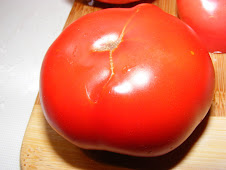
I use the word Naked as opposed to organic, non-gmo, non-hybrid, and other terms, because these are all kind of lumped together, as if they mean the same thing when they don't. I feel the word naked describes the tomato I want to grow. Pure, straightforward, old time strains of tomatoes, bursting with flavor, and all sorts of brilliant colors, these are not your hybrid perfectly round, perfectly bland supermarket tomatoes. These are tomatoes in their glory, blemishes, quirks and all. Grown with natural techniques, using no chemical fertilizing or pesticides.

I will share my growing tips and techniques, from choosing varieties and starting seeds, to lighting and watering, potting up seedlings, setting them out in the garden, bagging blossoms for pure seeds (or if you even need to bother), saving tomato seeds, soil nutrition, composting, and anything else I can think of related to gardening and success with tomatoes. Even if you've never grown a tomato plant, or started one from seed, you can follow along the process, and I bet you'll never go back to store bought tomatoes (except maybe in the dead of winter out of desperation) or buying those hybrids plants again.

I am also a Brugmansia (Angel's Trumpets) fanatic, so I will have the occasional posts and pictures of these beautiful tropical plants.

And I love to cook and bake, so I'm sure that will be there somewhere in the mix.

I hope I will get questions and comments. One thing I love about gardening is the generosity most gardeners have towards others. Walking in my neighborhood last summer, I complemented a woman who was weeding her garden on the gorgeous poppies she had growing, and she promptly cut off a few seed heads and handed them to me. I've had so many generous and kind people share little bits of their gardens and their time with me, I truly believe in the pay it forward philosophy when it comes to gardening.